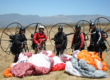
If you’ve ever searched for “paragliding near me” or wondered about the difference between a paraglider and a paramotor, you’re not alone. Both sports involve flying beneath a fabric wing high above the ground, but that’s where the similarities end. In this guide, we’ll break down everything you need to know about paragliding vs. paramotoring — including which one actually works in Texas.
What is Paragliding?
Paragliding is a non-motorized form of free flight. A pilot launches from an elevated point — usually a hill, mountain, or cliff — and glides through the air using a lightweight fabric wing called a paraglider. There is no engine or propeller involved. Instead, paraglider pilots rely on rising columns of warm air called thermals, ridge lift from wind hitting a hillside, and the natural elevation of their launch site to stay aloft.
Because paragliding depends on terrain and weather conditions, it tends to be best suited for mountainous or hilly regions. Popular paragliding destinations include places like the Swiss Alps, the coastal cliffs of Southern California, and the Blue Ridge Mountains. Pilots can stay in the air for hours when conditions are ideal, riding thermals to gain altitude and covering impressive distances on cross-country flights.
However, there is a significant drawback for anyone living in a flat region like South Texas. Without hills or mountains to launch from, traditional paragliding is extremely difficult — if not impossible. You simply cannot run off a flat field and expect a non-motorized wing to carry you into the sky. This is the primary reason why paragliding is not commonly practiced in the San Antonio area or across most of central and south Texas.
What is Paramotoring (Powered Paragliding)?
Paramotoring, also known as powered paragliding or PPG, solves the biggest limitation of traditional paragliding by adding a small motor and propeller to the equation. A paramotor pilot wears a lightweight engine on their back — called a paramotor unit — which provides the thrust needed to launch from completely flat ground. The wing itself is very similar to a paraglider wing, but the motor means you no longer need a hill, mountain, or any elevation at all to take off and fly.
This makes paramotoring the perfect flying sport for Texas. With wide-open fields, calm morning air, and flat terrain stretching as far as the eye can see, Texas is actually one of the best places in the country to learn and enjoy powered paragliding. You can take off from a grass field, climb to altitude under your own power, and cruise over the beautiful Texas landscape for as long as your fuel lasts.
Paramotoring falls under FAR Part 103, the Federal Aviation Administration’s ultralight vehicle category. This means that no pilot’s license is required to fly a paramotor in the United States. While a license is not legally mandated, professional training is strongly recommended for safety. A certified instructor will teach you ground handling, launch and landing techniques, weather assessment, and emergency procedures so you can fly safely and confidently.
The equipment is surprisingly portable. A complete paramotor setup — wing, harness, and motor — can fit in the back of an SUV or truck. Many pilots drive to their favorite flying sites, set up in minutes, and are airborne before sunrise. It is one of the most accessible and affordable forms of powered aviation available today.
Paramotor vs. Paragliding — Key Differences
Below is a side-by-side comparison to help you see how paragliding and paramotoring stack up against each other:
| Feature | Paragliding | Paramotoring |
|---|---|---|
| Motor Required | No | Yes |
| Takeoff Location | Hill or Mountain | Any Flat Ground |
| Best for Texas? | Difficult | Perfect |
| License Required | No | No |
| Average Cost | $3,000 – $6,000 (gear) | $8,000 – $15,000 (gear) |
| Training Required | Yes | Yes |
As you can see, both sports share some similarities — neither requires a government-issued pilot’s license, and both require proper training to fly safely. The biggest differences come down to the motor, the launch requirements, and the suitability for flat terrain like we have here in Texas.
Can You Paraglide Near San Antonio?
Technically, there are a few spots in the Texas Hill Country — roughly an hour northwest of San Antonio — where paragliding might be possible under the right conditions. However, the hills in central Texas are relatively modest compared to the mountain ranges that paragliding typically requires. Consistent thermal activity and suitable launch sites are limited, making paragliding an unreliable and impractical option for most people in the San Antonio area.
Paramotoring, on the other hand, is perfectly suited for our region. All you need is an open field and favorable weather conditions, both of which are easy to find in and around San Antonio. Instead of driving hours to find a suitable hillside, you can launch from local fields and enjoy stunning aerial views of the Texas countryside whenever conditions are right.
If you’ve been searching for “paragliding near me” and you live in or near San Antonio, powered paragliding is almost certainly what you’re looking for. It gives you the same incredible sensation of flying beneath a wing with the added freedom and flexibility of a motor — no mountains required.
Try Paramotoring in San Antonio with Lone Star Paramotor
Ready to experience the thrill of flight for yourself? Lone Star Paramotor is San Antonio’s premier USPPA and ASC certified paramotor school. Whether you’ve never flown before or you’re looking to transition from paragliding, we have training programs designed to get you flying safely and confidently.
Not sure if paramotoring is right for you? Start with a Discovery Flight — a tandem experience where you’ll fly with a certified instructor and feel what it’s like to soar above Texas. No experience needed, and it’s the perfect way to see if powered paragliding is your next adventure.
Ready to become a pilot? Our Beginner Pilot Training program covers everything from ground school to solo flight. You’ll learn ground handling, launching, flying, landing, weather assessment, and equipment maintenance — all from USPPA certified instructors who are passionate about getting Texas in the air.
Stop searching for paragliding near San Antonio and start flying. Contact Lone Star Paramotor today and take your first step toward becoming a paramotor pilot.